Escaping the Trauma Vortex
August 23, 2026
It can be easy to become overwhelmed by memories, emotions, and sensations related to past, painful experiences. Healing involves grounding into the tools and inner resources of your healing vortex.
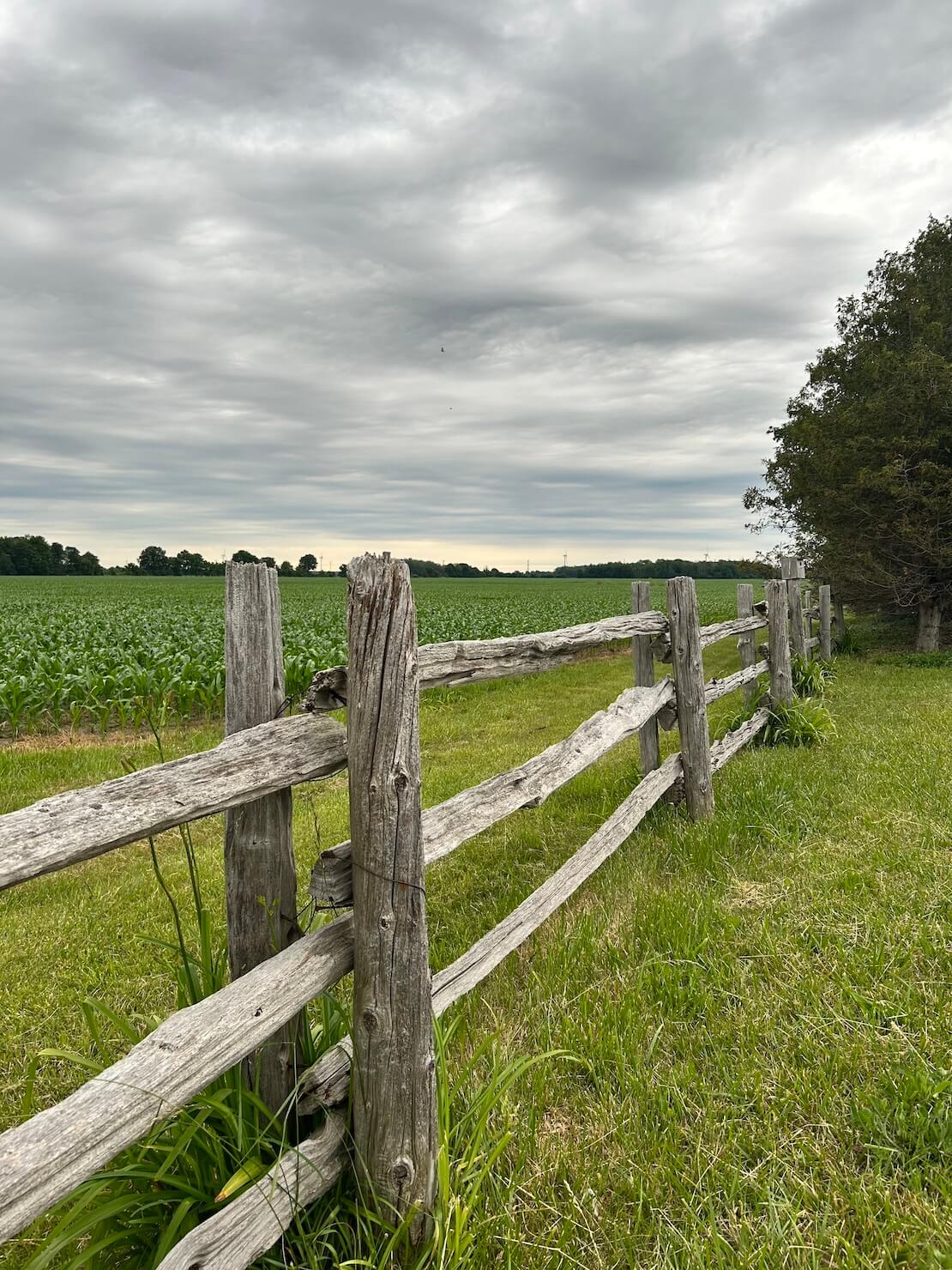
Driving back from the city, I pass through farm country, following a line of cars with their headlights on as they head west toward Lake Huron. The rolling hills of southwestern Ontario fade into the distance on either side of the road, hills that have been my companions for fifteen years, more than a quarter of my life.
Wheat and corn, and other plants I can’t identify as I zoom past in my car, dance in the breeze left behind by the thunderstorm that, by now, is well on its way to the U.S. border. In the sky, the sun has drifted behind a hazy cloud cover, and is now visible only as a reddish orange disk hovering about an hour above the horizon.
The shadows of the trees guarding the crops stretch long across the fields, slipping in between the leaves and stems to settle around the base of the plants, pooling there in murky darkness.
I feel the weight of my own shadows wrapped around me—grief, pain, and darkness, and the loss of the life I had been building for thirteen years with a woman I loved deeply. How long have I wandered through these shadows, tethered to the past?
Even as I move toward a future that remains unknown, another life lying somewhere below the horizon, a rough line in the distance that my healing journey brings me closer to each day.
I’ve been on this journey for almost twenty-five years, even longer if you count the subtle ways before then that I chased after stillness and peace, failed attempts at finding a light to guide me out of darkness.
Learning about trauma and attachment
For the past two years, my journey has intensified. Determined to finally break free of the patterns that have kept me stuck for so long, I poured all of my energy into healing. In the beginning of this phase, I was trapped in darkness and depression, so I had very little energy to spare.
But I had enough energy to learn about trauma, nervous system regulation, attachment theory, and relationships—reading books, listening to podcasts, and taking workshops and trainings, much of this content aimed at therapists and somatic practitioners.
For the first few months, I was trying to heal my own trauma while healing my relationship, even arranging for us to do couple therapy. When the relationship finally ended, I turned all my energy toward breaking free of my own patterns and shadows.
Since then, I have spent much of this time thinking about healing—how can I get better; what do I need right now; what darkness can I dive into today?
I also practice what I am learning—staying present with the emotions and sensations rising up in my body, often like a tidal wave; doing nervous system regulating exercises; resourcing by going into nature and connecting with animals, rocks, trees, wind, and water; opening up to safe people; holding space for others.
And I go to therapy regularly—every week for a while, and then biweekly after that, with two separate trauma therapists, one who specializes in somatic work, plus doing somatic parts work with a third practitioner in group sessions.
I have even taken two separate somatic practitioner trainings, one similar to Somatic Experiencing, the other Somatic Eye Movement Desensitization and Reprocessing (EMDR).
I went all in.
Feeling urgency to keep healing
Some of this urgency may have been coming from a part of me who thought that if I stopped actively healing, I would slip back into the darkness I had been stuck in for so long, the darkness that contributed to the end of my relationship (although I now know that the stress of that relationship also contributed to the darkness).
I might have kept going like this for years. But at one point, I realized that my intense focus on my healing journey had become a block to my soul’s journey.
I first heard this truth several weeks ago from my somatic therapist. “You are spending a lot of time in the trauma vortex,” she said, drawing a tornado-like squiggle on her whiteboard.
This sketch was meant to represent the feelings and sensations in my body related to the challenges and harms I experienced in my previous relationship and earlier in my life. Panic and fear, dissociation and shutdown, fawning and self-abandonment. It was actually a good representation of what it felt like in the middle of that relationship and for a long time afterward.
Trauma vortex is a term described by Peter Levine, PhD, in his book Waking the Tiger. Levine developed Somatic Experiencing, a type of naturalistic therapy that helps resolve trauma. According to practitioners of this therapy, the body already knows what to do in order to heal, but it may need support to help it remember its own wisdom.
Touching into the trauma vortex
In Somatic Experiencing, part of the healing process involves touching the edges of the trauma vortex, with the help of a practitioner, and gently metabolizing a little bit of the activation energy to help it move through your body. This is repeated gently and slowly until more of the activation has been resolved.
For people who have experienced severe trauma, it is easy to get sucked back into the trauma vortex—like an emotional whirlpool—and become overwhelmed by memories, emotions, and sensations related to past, painful experiences. This can potentially cause you to be re-traumatized.
To help you brush against the activation without getting swept away, Somatic Experiencing also utilizes the counter vortex. This healing vortex consists of tools and inner resources that enable you to cope better, think more positively, and free yourself from trauma-related patterns of the past.
The healing vortex exists in all of us. It is an extension of our inherent life force. It shows up in a present moment of stillness, in the co-regulation with a safe person, and in our connection to nature.
For those who struggle with the effects of trauma, the healing vortex may need encouragement and support to grow. However, it is still there, even if it is hard to see in the beginning.
Shifting toward the healing vortex
After my therapist described the trauma vortex to me, she added, “I’d like you to spend more time in the healing vortex,” drawing a happier squiggle above the trauma vortex. She suggested I do more activities that I love, that light me up.
She even gave me a two-page list of potential activities from the The Dialectical Behavior Therapy (DBT) Skills Workbook, things I can do in order to distract myself from overwhelm and activation when they arise—talking to a friend, exercising, spending time in nature, eating my favorite ice cream, and many others.
“So … no more listening to podcasts about trauma?” I said, half-joking.
“No,” she said, with a slight smile, the same look she often gets when I already know the answer to my question. “I think you’ve listened to enough of those for now.”
This conversation happened several weeks ago. Have I stopped listening to trauma podcasts entirely? No. I’m not always that great at doing what my therapist suggests, especially if it means doing less. Since then, I’ve also taken trauma-related workshops, ones that will help me be a more effective somatic practitioner.
However, I have cut back on consuming trauma-related content. I often listen to only ten or fifteen minutes of a podcast before putting on some music that I like and dancing and singing in my home or car.
Or I turn off the podcast and connect with the natural world around me. Or I put my hand on my heart and spend a few moments noticing which emotions and sensations are present in my body.
A few times, as I drove down a country road, I reached out my hand toward the fields and felt the energy flowing through the corn, wheat, and other crops.
Holding activation while healing
Since I started doing this, I have felt a shift. The urgency to consume everything I can about trauma has faded. And I notice sooner when I have moved beyond the capacity of my nervous system to listen to people talking about trauma.
For most of my life, I thought that if I started something, I had to finish it, even if it meant ignoring the signals coming from my body. I am letting go of that, something I wish I had been able to do ten years ago.
In spite of this, I still feel the shadows of my past lurking nearby. I still feel a pull toward getting smaller, often when I am sucked back into memories of my relationship, or when I am about to take a big step in my life.
I still dissociate when reminded of that relationship, even if the connection isn’t conscious. And panic and overwhelm still emerge out of nowhere, sometimes strong enough to almost sweep me away.
However, after months of somatic therapy and embodying this work in all its messiness, I have greater capacity to hold all of this. I may still feel like I am going to be swept away, but I rarely am. Not the way I would have been a year ago, when minor overwhelm could plunge me into darkness for days or weeks.
Even so, as I move closer to living a more authentic life, a life that will make my soul sing, I find myself encountering more internal resistance, maybe even more resistance from the universe.
This, too, feels like a vortex. A swirling maelstrom of patterns and fears keeping me from that new life. In the past, all I saw were those patterns and fears. But now I know that beyond that storm, a new life is waiting to welcome me home, waiting to welcome me back to myself.
I just need to keep moving ahead, slowly and gently, trusting that the path I am forging through the wilderness will carry me there safely.
Leave a Reply
Based in Ontario, Canada
Receive inspiration for accessing your body's wisdom.
